
Ludwig Link

Gene-engineered stem cell therapy for GBM passes its first test

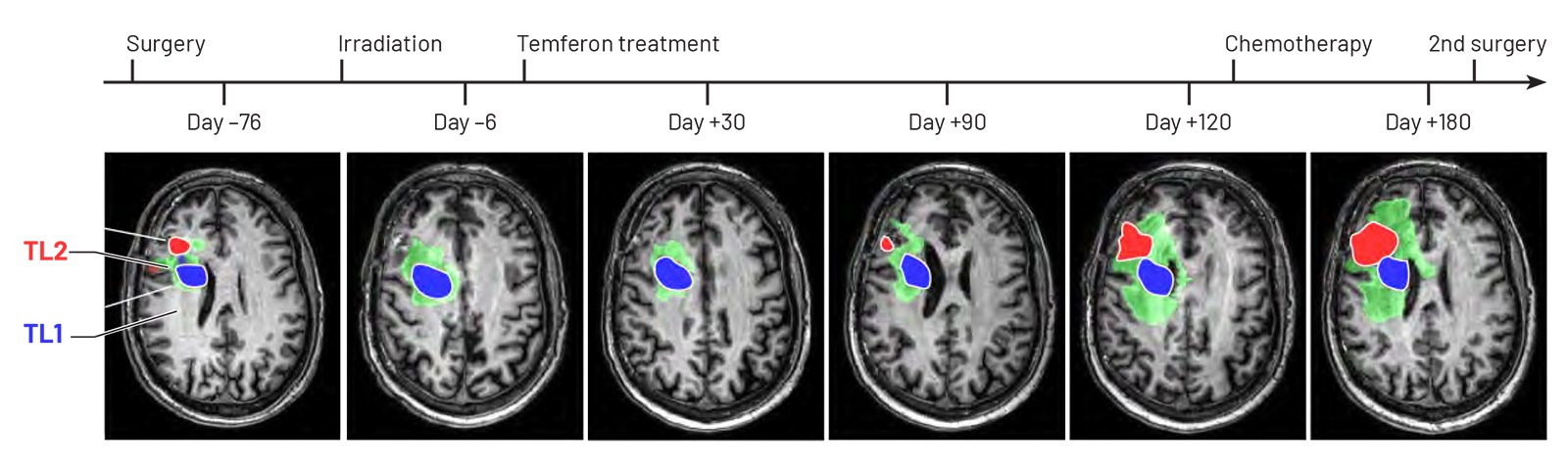
The MRI scans show the evolution of GBM over time in a patient treated with Temferon. After partial surgical resection, the largest target lesions (TL) remaining were TL1 (blue) and TL2 (red). The light green areas are perilesional edema. TL2 disappeared after radiotherapy, while TL1 was radioresistant. Over time, TL1 remained stable, and a biopsy revealed a high frequency (16% of TAMs) of TIE2+ macrophages (TEMs) and the presence of a strong interferon response signature, consistent with infiltration of Temferon progeny and activation of the TIE2 promoter-driven IFN-α transgene. The opposite was true for TL2, which recurred at 3 months and continued to grow.

The MRI scans show the evolution of GBM over time in a patient treated with Temferon. After partial surgical resection, the largest target lesions (TL) remaining were TL1 (blue) and TL2 (red). The light green areas are perilesional edema. TL2 disappeared after radiotherapy, while TL1 was radioresistant. Over time, TL1 remained stable, and a biopsy revealed a high frequency (16% of TAMs) of TIE2+ macrophages (TEMs) and the presence of a strong interferon response signature, consistent with infiltration of Temferon progeny and activation of the TIE2 promoter-driven IFN-α transgene. The opposite was true for TL2, which recurred at 3 months and continued to grow.
Bernhard Gentner, Ludwig Cancer Research Lausanne
Bernhard Gentner

Monocyte-derived macrophages and microglia help maintain an immunosuppressive microenvironment in glioblastoma (GBM) tumors. During chemo and radiotherapy, these macrophages are often replenished by hematopoietic stem/progenitor cell (HSPC)-derived monocytes recruited from bone marrow. Researchers led by Ludwig Lausanne’s Bernhard Gentner figured they’d turn those recruits into double agents and reported in a June issue of Nature Medicine the first clinical evaluation of a genetically engineered stem cell transplant, Temferon, devised for that purpose. Temferon harnesses HSPC-derived macrophages for the targeted delivery to tumors of interferon-α2 (IFN-α) to locally activate antitumor immunity. Bernhard and his colleagues used it to treat patients with an aggressive subtype of GBM tumors that bears an unmethylated MGMT promoter. No dose-limiting toxicities were observed in 24 newly diagnosed GBM patients. Median overall survival and progression-free survival were 16.7 months (median survival for this subtype of GBM is 11-14 months) and 8.1 months from diagnosis, respectively. Two of the trial enrollees have, remarkably, survived more than three years following their initial surgery. The study resulted in an enduring engraftment of engineered HSPCs in the bone marrow and minimal systemic exposure to IFNα, which is notably toxic. The researchers also demonstrated that Temferon progeny were recruited into GBM tumors, where they locally secreted IFNα to reprogram myeloid and T cell compartments capable of tumor control.

Tumor-targeted interferon-α gene therapy for glioblastoma: a phase 1 trial
Nature Medicine, 2026 June 1

 Back to September 2026 Ludwig Link
Notice
?

You are now leaving Ludwig Cancer Research's website and are going to a website that is not operated by the association. We are not responsible for the content or availability of linked sites. Do you wish to continue?

Continue
Cancel