
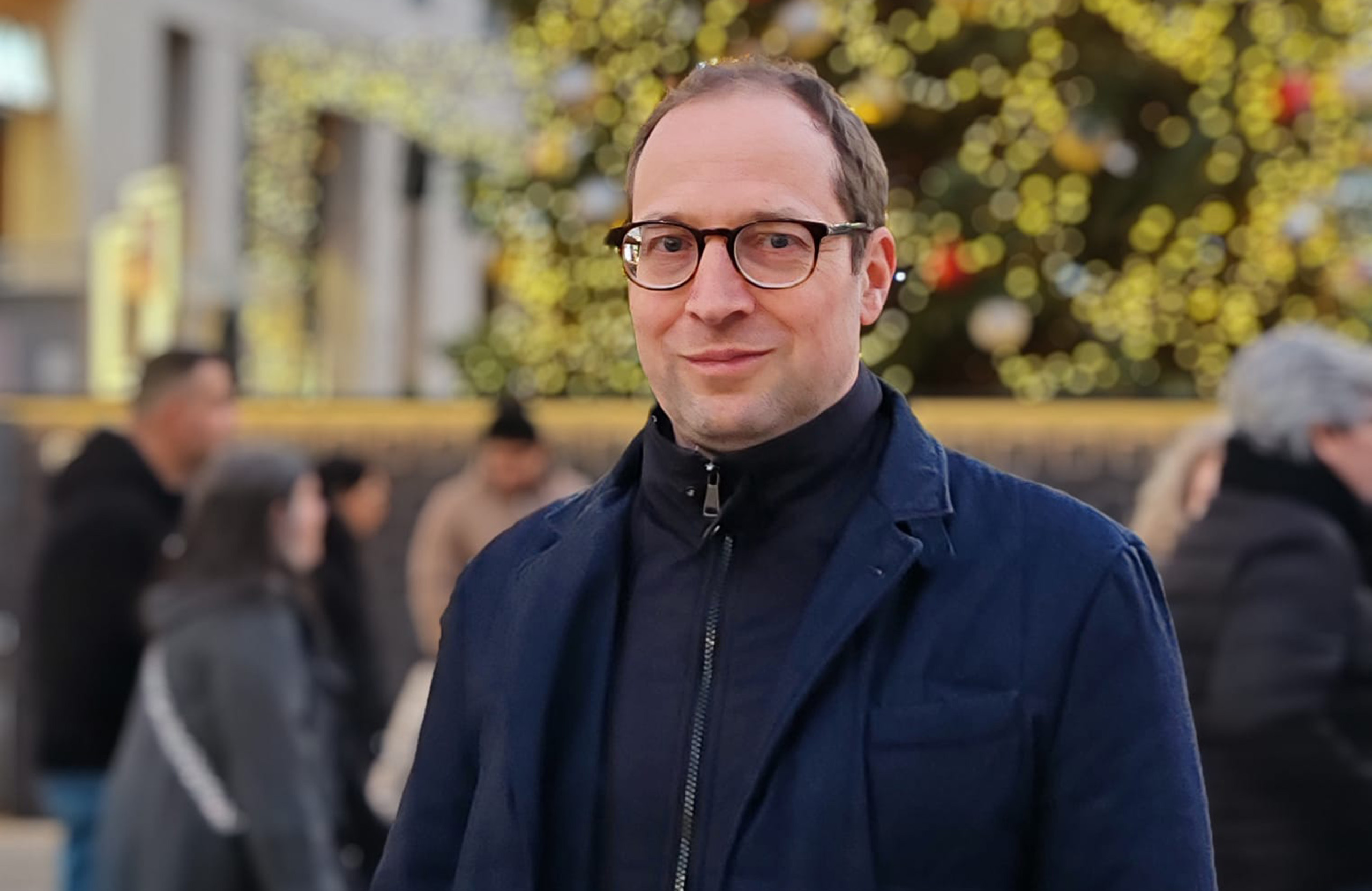
Bernhard Gentner
Ludwig Lausanne
Tell us a bit about yourself. Where are you from, where were you raised?
I grew up in a very small village in the south of Germany. My father was an electrical engineer and a high school teacher. My mother was an administrative clerk, but she decided pretty early to use her time to raise me and my two brothers, which is a full-time job, as you can imagine. It was a wonderful childhood. We had a huge garden. My parents were just great—my mother was very caring, always there for me, and my father taught me that hard work, discipline, and performance can bring you forward in life. I think this was very important for how I approached university and also research afterwards. He also always encouraged me to go abroad and to learn about other environments and other systems, and this was very helpful. My childhood dream was to be a pilot, but my eyesight was unfortunately not good enough. As a second choice, I decided to become a doctor.
How did you get into gene therapy?
This basically goes back to high school. We had a good biology teacher. He was very much up to date, because in 1995 he told us one day that a child with severe combined immunodeficiency, the so-called bubble boy, had been treated with gene therapy at the NIH. That was, for me, extremely inspiring—this idea that we can do gene therapy, we can correct genes. Then I went to medical school in Heidelberg—it’s a major science hub in Europe. So I was immersed in that environment and got excited about doing research, not just clinical work. So I wanted to do an experimental doctoral thesis there, and as luck would have it, I stumbled across a gene therapy project. The goal was to develop technologies to identify retroviral integration sites in repopulating stem cells exposed to an experimental gene therapy protocol. And I jumped onto this project, and worked almost three years full-time to develop the technology. And that’s how I came into gene therapy during university. And I managed to do this in parallel with my medical studies.
And what made you pursue oncology?
My grandfather died from small cell lung cancer when I was little, and I was always very much scared to develop a cancer. Then I got exposed to oncology quite a lot in the last year of medical school in oncological surgery in Houston, Texas, at the MD Anderson Cancer Center, and in my first three years as a physician, when I worked in medical oncology for my residency in Erlangen, Germany. I have to say it was depressing for me, a frustrating experience, because this was before immunotherapy came in, so you basically couldn’t cure these patients. You gave some chemotherapy, and then they relapsed. I thought, I don’t want to work in medical oncology. But then I got very passionate about hematology because at least there was a fraction of patients you could cure in those days. And I also saw that most innovations—including targeted therapies and cellular immunotherapies—were pioneered in the setting of liquid cancers. So I pretty much shifted my focus and specialized in hematology and bone marrow transplantation in Milan, at the San Raffaele Institute.
What is your main clinical focus, and your connections and collaborations here?
My main focus is cellular therapy. I worked many years on allogeneic hematopoietic stem cell transplantation—I was lucky to work in Milan, in a center that was at the forefront of alternative donor transplants, which taught me how to manage ultra-complex patients, some needing semi-intensive care that we administered ourselves on the floor. That was very enriching from a medical perspective, because we were doing the real doctor work, not just calling the consultant. But my real passion remained gene therapy. With industrial collaborations, we had the opportunity to bring treatments from the bench to the patient, and then even to the market. I understood that it doesn’t finish with a phase one study where you get a nice paper. The real work starts afterwards, developing it into a drug, and I had the opportunity to see several programs in Milan successfully go this way. There’s unfortunately a crisis right now with ex vivo gene therapy, because the industry feels it’s not a good business model—it’s a very expensive personalized treatment, paired with very high regulatory requirements, resulting in high costs. But I feel there’s a lot of untapped potential in the new genetic engineering technologies. That’s really where my passion lies.
What convinced you to move here and become affiliated with the branch?
I think professional growth was one of the drivers, and to get a little bit away from the rare disease indications. And an impressive infrastructure was in place here, thanks to [former Ludwig Lausanne Director] George Coukos, who did a fantastic job in setting all this up and creating this environment and infrastructure. It is unique in Europe, I would say. And I realized there is potential here to do translationally oriented team science, to develop cutting-edge new cell therapy approaches for cancer, in a center focused on cancer. I wanted to combine my clinical responsibilities with my research activities.
Tell us about the myeloid cell reprogramming work you’re doing.
The idea is to reprogram the myeloid cell, because we know it’s a key component of cancer ecosystems, often responsible for resistance to treatments and for cancer progression. There’s a huge heterogeneity of different myeloid cell states. If you do treatments based on the mature myeloid cells, there will always be a way that the body, the cancer, will compensate for that function you block. So my vision is to go into the progenitor, or the stem cell, and influence the myeloid cells that will be recruited into the cancer. We’re exploring different ways to influence the cancer ecosystem. One is delivery, generating specific transcriptional modules which release anti-cancer molecules, like cytokines and T cell engagers, locally within the tumor microenvironment. The other is reprogramming the myeloid cells. But you need to also work on the T cell side, combine it with some immunotherapy that enables the T cells to perform. So my lab is trying to find these synergistic combinations of myeloid-directed and T cell-directed approaches that would make a difference for selected cancers.
You recently reported the results of a Phase 1 clinical trial of Temferon, which uses hematopoietic stem/progenitor cell-derived macrophages for the targeted delivery of interferon-α2 (IFN-α2) to tumors. Are you moving forward with that?
Absolutely. It was a very successful trial in my opinion, even though it’s always hard to make any claims on survival when you do a phase 1 study without a control cohort. But the fact that we saw multiple patients that survived long-term, so beyond two years for this subset of glioblastoma (GBM), this is, let’s say, noteworthy at least. And also, the two longest surviving patients developed a late response to the treatment, without any additional treatment. Together with the biological data from this work, this clearly indicates that there is a possibility to reprogram this microenvironment in GBM. I definitely see the potential to bring this to the next level, with a new, improved construct and combination therapies to better engage the T cell compartment.
Any favorite music?
I like different kinds of music. On one hand, I like classical music very much. The older I get, the more I enjoy classical music because it’s relaxing. But I also still like rock in general—what was “in” in the 1990s, like Guns N’ Roses, that kind of stuff.
What’s the best career advice you received?
I think the best advice is, work hard and smart. It’s not sufficient to be a hard worker, because you are maybe not asking the right question, and maybe you’re becoming inefficient. You have to also be very smart and have a clear plan for what you’re doing. So I think you need both—work hard and smart.