
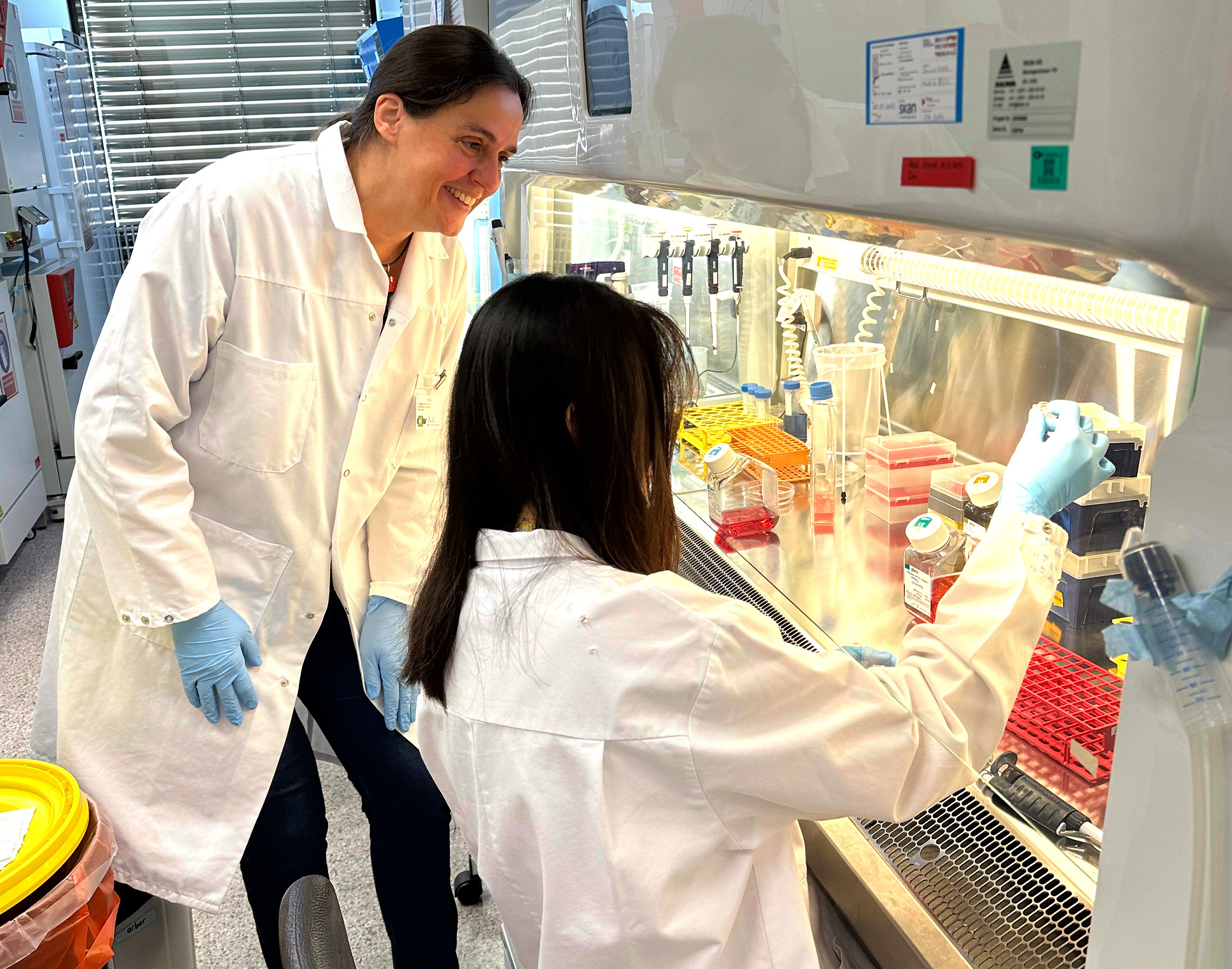
Caroline Arber
Ludwig Lausanne
Tell us a bit about yourself.
I’m from Switzerland. I grew up in Basel, a small town on the border with France and Germany, with my sister and my parents. When I was four years old, my dad received the Nobel Prize in Physiology or Medicine for the discovery of restriction enzymes. I had no idea what it meant, but I had the feeling that it was something very important. I was doing a painting class, and they gave me a big white piece of paper and said, “Just put something that makes you feel something important happened.” I remember that I just drew one huge flower. My parents have hung this painting at their place, and it’s kind of a memory of that important event. This experience certainly influenced my personal life and my professional development. We were often accompanying my dad to scientific meetings together with my mom, and we had the opportunity to meet renowned scientists. This was a very special and amazing experience for me.
After finishing high school, I was drawn into medicine because I felt that I needed to understand the human body, the different disease pathologies and how they were treated. Already during medical school, I was also attracted to translational research and interested in hematologic oncology. I liked the very strong lab component, which is important in the diagnostics of blood cancers but also for stem cell transplant and cell therapies. So I trained in internal medicine and hemato-oncology and complemented that with research experience at Stanford University. And after becoming a heme-onc and cell therapy specialist, I joined Baylor College of Medicine, where I really became passionate about immune cell engineering and clinical trials with genetically engineered cells to treat malignancies and infections.
What are your main clinical and research interests?
My main clinical focus is on cellular therapies, and in particular immune effector cell therapies. So, in the routine clinical activity, I have established—together with key clinical colleagues—the CAR-T cell program in the Department of Clinical Oncology at CHUV for all available indications in hematologic oncology, in collaboration with pharmaceutical partners. And since 2024, I’m a co-director of our clinical cell therapy program. My research focus is also on cell therapies. In my lab we engineer new receptors for CAR or T cell receptor (TCR) based T cell therapies, with a focus on future translation to first-in-human clinical trials. So my clinical focus and my research focus are connected. One example of a clinical trial where I have an important role is the T cell therapy for NY-ESO-1-positive sarcoma and for melanoma, where we know that a proportion of patients have high levels of NY-ESO-1 expression. It’s a class I TCR directed against NY-ESO-1, and the TCR is expressed as a transgene in the patient’s T cells, manufactured individually for each patient. It started last year, and our team has now treated four patients.
Whom have you collaborated with at Ludwig Lausanne?
I collaborated with Ping-Chih Ho on the impact of metabolic interventions on CAR-T cell therapies, to modulate the potency of the product, and we have tested that in preclinical models together. I’ve also worked with [former Ludwig Lausanne Director] George Coukos and [fellow Clinical Scholar] Bernhard Gentner in developing clinical trials with locally produced immune effector cells. For the NY-ESO-1 TCR study mentioned above, I’m the sponsor representative for the CHUV, as this is an academic investigator-initiated trial, and Bernhard is the clinical PI.
Tell us a little about your work on CAR-T cell design?
We have recently designed a new chimeric antigen receptor. We are finishing up the preclinical data package and are moving that into a first-in-human clinical trial for acute myeloid leukemia. We are targeting an antigen called CD70, and for that we used the natural ligand for the target. We first optimized the cell surface stability and signal transduction capacity of the CAR backbone. And then, in collaboration with a computational protein design lab at EPFL, we optimized the interface of the ligand:receptor interaction to make it highly antigen-sensitive. So this CAR is actually able to detect very low levels of antigen, and that helps us with the heterogeneity that we find in these leukemias—some patients have high levels, some patients have low levels, and even within the patient we find different levels on different leukemia cells. So having a very sensitive CAR will help us to tackle a big proportion of these leukemic cells in the patient. We have obtained funding with philanthropic support to move this into a clinical trial. The trial could open in about a year from now.
What else are you doing in your lab?
We are also designing other chimeric receptors, not CARs, but receptors that can sense input from the tumor microenvironment. We think that for solid tumors, which are rich in soluble factors and cellular components that are immunosuppressive, we can use a second receptor to give the T cell an additional input and an advantage to overcome this immune suppression and reduce their exhaustion. So now we are using basically two components on one T cell to cooperate and give it the capacity to better infiltrate solid tumors, overcome exhaustion signals and give it the signals to persist long-term.
What do you like most about working closely with patients?
I really like the personal interaction with people. We need to find solutions to go beyond the standard of care, and to really give patients options to participate in clinical trials that can potentially help them even when all standard treatments have been exhausted. That’s one of the key driving motivations for me.
Which emerging technologies in your field excite you the most?
What I find extremely exciting are the in vivo gene modification tools that are now coming up for established targets of CAR-Ts. So now there’s the option to create the CAR-T in vivo. And then other technologies that I think will help us to better choose our targets, our modulators, our drugs, are the ’omics tools—the single-cell and spatial ‘omics that help us to understand the microanatomy of tumors that we are trying to tackle and, together with artificial intelligence, to select potential combinations of treatments, combinatorial drug options based on molecular features. I think these technologies are very exciting.
Tell us a bit more about yourself—your hobbies, and how you spend your spare time.
I have two kids, and my husband and I love spending time with them. They are twelve and nine. We like to do outdoor activities with them, like hiking or skiing. Or we explore art exhibitions. And when I’m by myself, I play the violin. I also like to play chamber music with friends. I started playing when I was six, and I’ve been playing ever since. My kids play the piano, both of them, and my husband also plays the violin. So we can start playing together.
Do you have any favorite books or music?
I love to go to concerts and listen to chamber music, so again I’m more on the classical side. I really like the quartets of Beethoven. And for symphonies, I’m more into late 19th and early 20th century composers.