
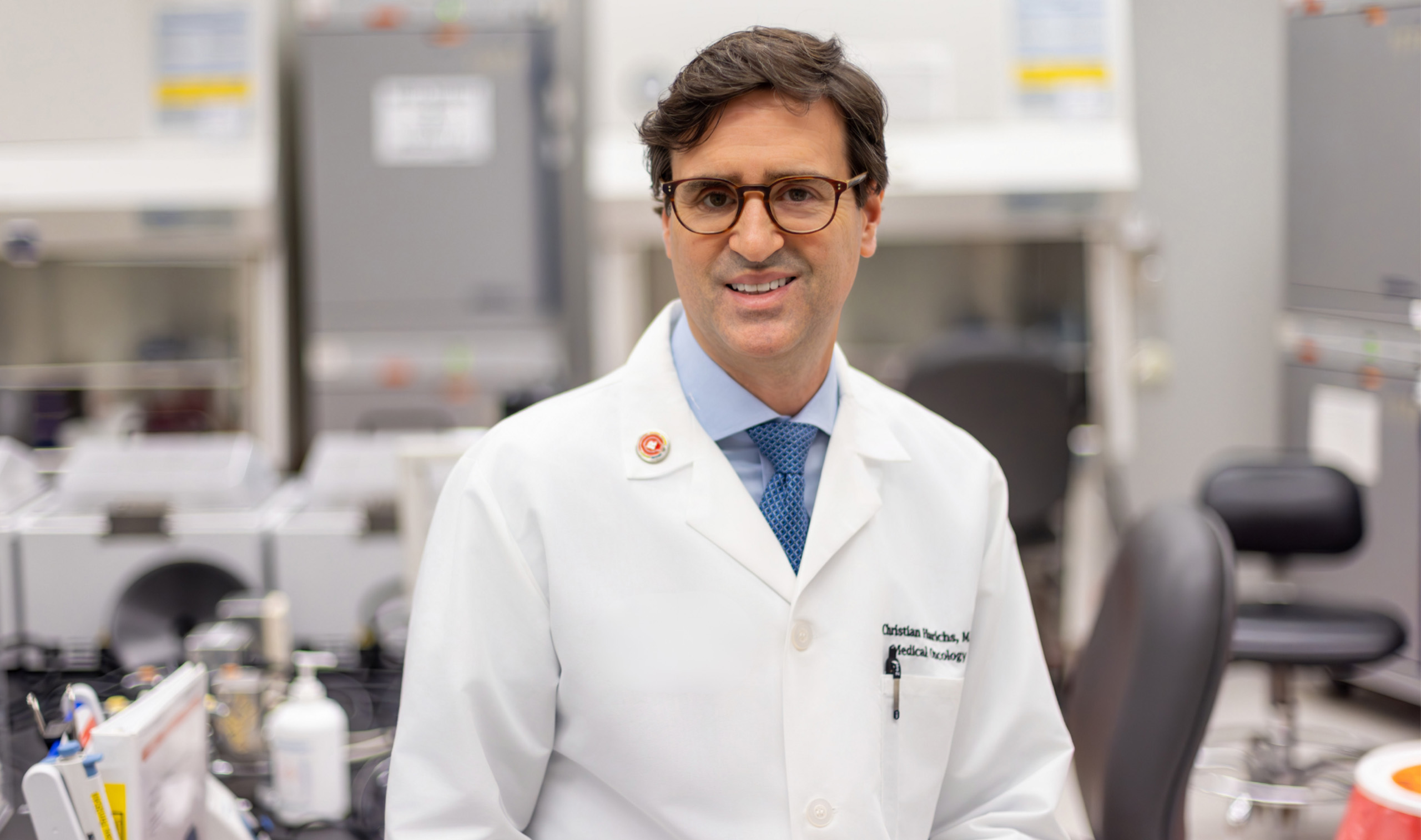
Christian Hinrichs
Ludwig Princeton
Tell us a bit about yourself—your family, where you grew up.
I grew up in St. Louis. I actually committed to medicine when I was 17, in high school, and went to a combined six-year BA/MD school at the University of Missouri–Kansas City (UMKC). I have a brother who’s a couple years younger than me, and my mom and dad are no longer living, but we all grew up in a house in St. Louis. I loved science, and my grandfather was a physician—he was actually a third-generation physician, I think, so it makes me the fourth in my family. I really admired him and was kind of inspired by him. He actually ended up being one of the early physicians in what was at the time called industrial surgery, but it evolved in his lifetime into occupational medicine. He started an occupational health practice in downtown St. Louis when he got back from World War II—he was an Army doctor.
How did you wind up in the world of cancer research?
After the six-year BA/MD, I stayed at UMKC and I did a five-year general surgery residency there. When I was doing surgery, I realized that a lot of general surgery, at least at that time, was actually oncologic surgery. But I thought that should really be a specialized field, where you understand the disease you’re treating. So I wanted to learn more about cancer surgery, and did a two-year fellowship at Roswell Park Cancer Institute, in Buffalo.
During the fellowship, the limitations of surgery in treating cancer became even more apparent. We had some particularly compelling and emotional cases, where we did big operations on young people, and their cancer came back before they were even healed. That had a big impact on me. I was able to obtain a position in a research fellowship at the National Cancer Institute (NCI), in what’s called the surgery branch, which was known as more of an immunotherapy center than actually a surgery place. That’s where the early development of IL-2, under Steve Rosenberg, was happening. IL-2 was an early immune-based treatment for melanoma and kidney cancer. And the work there extended into cellular therapies. I went into a laboratory there focused on developing more potent cells for these treatments and it turned out to be a great experience. I ended up being there for six years, basically in a postdoc type of position.
About five years into it, though, I lost my right eye to an ocular melanoma. It’s a rare kind of cancer. I had to stop operating as a surgeon because my depth perception was thrown off by monocular vision. I was, at that point, six years in as a laboratory researcher, trying to make cells more potent. But on the clinical side, we were just starting to genetically engineer cells to be able to target specific antigens in the tumor. That engineering approach was really interesting, but the early trials targeted proteins that were expressed more on tumors but also on healthy tissues. In pretty much all cases they would cause horrendous toxicity.
Observing that, I was thinking, well, how am I going to make the cells stronger if everything’s limited by this toxicity from targeting healthy tissues? And putting it all together, I decided, okay, I’m going to retrain in internal medicine and medical oncology, and become a medical oncologist. At this point, I was, I think, 40-ish, and had a one-year-old kid at home. I got a year of credit in internal medicine from my prior clinical training, so I started as a second-year resident, and did a medical oncology fellowship at the NCI. On the back end of that fellowship, I went into Steve Rosenberg’s main lab group, and I said, “Steve, I want to do clinical trials to treat cancers that are caused by human papillomavirus.” My rationale was that when HPV causes cancer, it does it primarily through two proteins, E6 and E7, and they continue to be present in the tumor cells as they divide. They’re expressed by all of the cells in the tumor, as far as we know, and they’re not expressed by any healthy cells, because they came from a virus. So to me, this was the place to do proof-of-concept studies, to develop cellular therapies for epithelial cancers that express these specific viral antigens, E6 and E7.
Tell us about that first clinical trial.
So the first trial I did was with an approach that we call TIL, or tumor infiltrating lymphocytes. For this, we grow the T cells out of a patient’s tumor, test the cultures for reactivity against the E6 and E7 oncoproteins, grow them up, and give them back to the patient. In that trial, we saw tumor responses in a little over a quarter of the patients. In some patients the tumors completely went away. Two patients with cervical cancer had no evidence of disease 10 years after treatment—very dramatic, because both had been told, “Get your affairs in order.” That was, to me, kind of a first-generation approach, because it requires surgery, takes a long time to grow the cells, and the cells target whatever they target. What I’d always wanted to do was an engineered approach. It took some time, but our team identified a T cell receptor that targets the E7 oncoprotein—which we then evaluated in an engineered cell therapy trial at the NCI. We saw some really dramatic tumor responses, but we didn’t cure anyone, and we also came to understand some of the mechanisms of resistance.
And now, at Rutgers?
So with that in mind, I was recruited to Rutgers, where I set up the cell therapy program. One of the main trials is a phase 2 trial with that engineered E7 TCR approach. Based on what we learned about the mechanism of resistance in the first trial, we’re selecting patients more likely to respond. Of the first 10 patients, six had tumor responses including two complete responses that were ongoing at 11 and 12 months after treatment.
We do have another active clinical trial going on. I had a patient—one of the TIL patients who had all their cancer go away—and when I studied the cells that we gave her, it turned out that the main targeting was actually not against HPV. Two-thirds of the cells that we gave her had the exact same receptor, targeting the exact same antigen—something called KK-LC-1, from a class of cancer antigens commonly targeted in oncology, called cancer germline antigens. It’s actually commonly expressed in cervical cancer, maybe in the range of 30% or 40% of the tumors, and surprisingly uniform when it occurs. So there’s definitely a fraction of patients who have uniform expression of this target antigen in their tumors, and we have a phase one clinical trial targeting it that’s active now.
Could these approaches be extended to other cancers as well?
Yes, absolutely. The KK-LC-1 TCR I mentioned is also being studied for KK-LC-1-positive gastric adenocarcinoma, lung adenocarcinoma, and triple-negative breast cancer, in addition to cervical cancer. The HPV-targeted approach also covers some territory, because throat cancers, the oropharynx region specifically, about 60 to 70% are caused by HPV—actually a growing group. And HPV can also be found in cervical and other genital cancers like vulvar and vaginal cancers and in men, penile and anal cancers. We’ve actually seen a few esophageal cancers too, probably an extension of the head and neck process. Yeah, I think there are a fair number of patients who could benefit.
Tell us a little about your collaborations with Ludwig Princeton.
One area where we’re doing research, and have funding, is in studying the metabolic requirements of the T cells that we’re generating for therapeutic use. This is in collaboration with Eileen White and Geoff Markowitz, who’s actually the most central person at Rutgers working on this. This collaboration also intersects with other investigators, like [Ludwig Princeton Director] Josh Rabinowitz, and we are also participating in the newly funded Weill Cancer Hub East, a collaborative effort that includes investigators at Ludwig Princeton and Weill Cornell. It is a very exciting concept—to study the T cell and host metabolic demands in vivo in humans, after we give them cell therapies.
Tell us a bit about your hobbies, family …
I am married and my wife works in clinical development in the pharmaceutical industry, so we have interesting dinner conversations, crossover a lot. We have two teenage sons. I spend a lot of time with my family, and I like to run, and I do resistance training, sometimes with my kids.
Do you have any favorite music, a favorite book?
Well, so yeah, I do have favorite music, but I tend to listen to niche alternative, mostly rock, country, folk sort of bands that no one else has ever heard of. Sometimes I go to concerts with a friend of mine in Washington D.C. who has the same taste, and sometimes with my brother in New York. But usually it’ll be at a venue that’s in the range of a hundred to 2,000 people, not a bigger place with bigger, better-known bands. I love Sturgill Simpson for example. Another band I went to watch recently is called Brown Horses. I don’t do a lot of recreational reading. Most of what I read is science and news, especially articles about technology, which I enjoy.