
A new Ludwig lab, and an accomplished director, at Weill Cornell Medicine
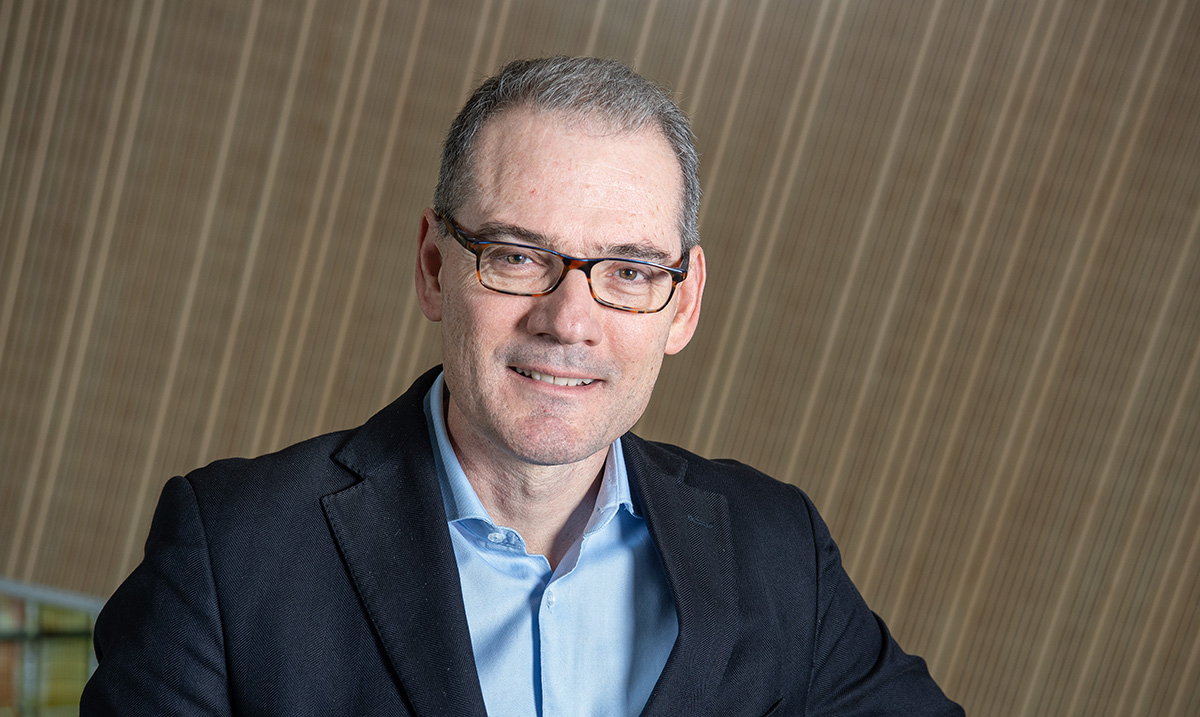
Eric Deroze/CHUV
The Ludwig Laboratory for Cell Therapy will be led by George Coukos, former founding director of the current Lausanne Branch of the Ludwig Institute.
The Ludwig Institute for Cancer Research announced in February the opening of the Ludwig Laboratory for Cell Therapy at Weill Cornell Medicine. Its Director is George Coukos, who recently returned stateside following an extraordinarily productive tenure as the founding director of not only the current Lausanne Branch but also of the Department of Oncology at the University of Lausanne (UNIL) and its hospital, CHUV. Ludwig Distinguished Scholar Douglas Hanahan will serve as interim director of Ludwig Lausanne until a permanent director is appointed.
The Ludwig Laboratory for Cell Therapy will explore tumor immunology and apply cell engineering, synthetic biology and AI to translate its discoveries into next-generation personalized T cell therapies for cancer patients. The launch of the laboratory marks a strategic step for Ludwig, continuing and expanding the Institute’s focus on next-generation cell therapies and integrating their underlying discovery science with clinical translation at a top medical institution.
You’d be hard pressed to find a better candidate than George to lead such an effort. As director of Ludwig Lausanne, he conceived, built and ran an ambitious and highly collaborative bench-to-bedside research program for the development, production and clinical evaluation of cellular immunotherapies and cancer vaccines. All this he did while continuing to contribute impressively to the basic and translational exploration of tumor immunology.
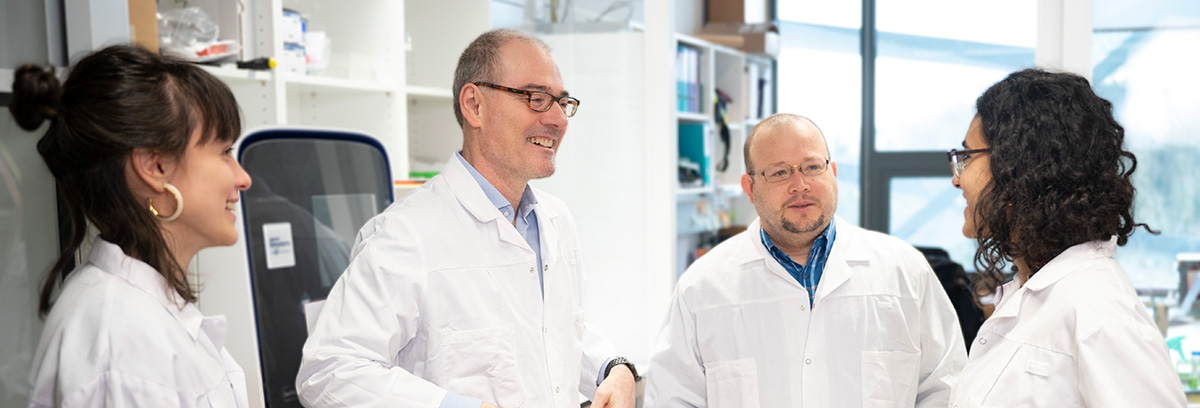
Gilles Weber/CHUV
George in his lab, chatting with members of his former Ludwig Lausanne team, Ioanna Rota (left), Jesus Corria and Laura Cabizzosu (right).
None of this was by accident. A physician and renowned scientist, George was already an authority on ovarian tumor immunology with a tenured job when he surprised his colleagues at the University of Pennsylvania more than a decade ago with the news that he was heading off to Switzerland to run an ambitious and entirely different kind of experiment in Lausanne. With the Ludwig Institute’s support, he told them, he would try to establish a world-class center for personalized immunotherapy in Lausanne.
“I felt the time was right to think big and capitalize on key scientific breakthroughs and technological advances in the field to develop personalized cell-based immunotherapies that would fill a key gap in modern cancer therapeutics,” George recalls.
And fill that gap he certainly did. Chief among his accomplishments at Lausanne was the advancement of dendritic cell (DC)-based cancer vaccines and adoptive cell therapies (ACT) and development of streamlined production methods for their clinical use. ACT involves the isolation from patients of T cells, their expansion in the lab and subsequent reinfusion for cancer therapy. In collaboration with George, Ludwig Lausanne researchers developed increasingly sophisticated, AI-driven computational methods to identify neoantigens—which are unique to the tumors of individual patients and most likely to elicit a productive therapeutic response. These “neoAg peptides” are being applied to develop DC vaccines and T cells for ACT in clinical trials.
George and his colleagues also devised methods to home in on tumor-infiltrating T lymphocytes (TILs) for ACT that might most effectively target those antigens. They then combined the technologies to create NeoTIL-ACT, which selectively enriches therapeutic TIL cultures with T cells most likely to target a given patient’s tumor. They applied neoAg peptides to the production of DC cancer vaccines as well.
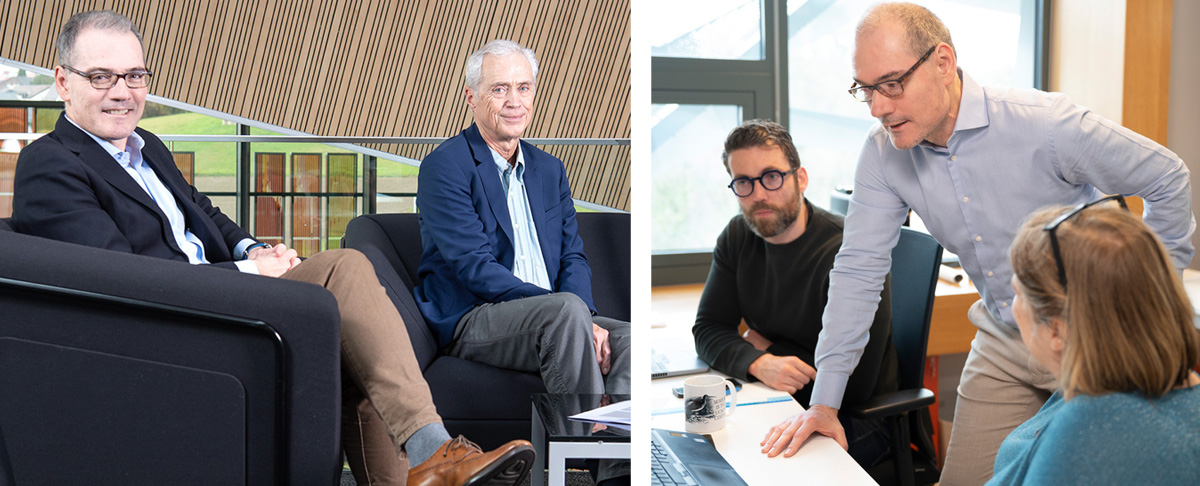
Left: Eric Deroze/CHUV. Right: Gilles Weber/CHUV
Left: George with Ludwig Distinguished Scholar Douglas Hanahan, who will serve as interim director of Ludwig Lausanne until a permanent director is appointed. Right: Findings from studies led by George, shown here with Arthur Mulvey (left) and Catherine Ronet, were often applied to devise experimental cell therapies for cancer patients.
Early phase clinical trials in Lausanne evaluating DC vaccines and ACT—including NeoTIL-ACT—have produced encouraging results against several types of highly advanced cancers. Beyond that, George continued his exploration of basic and applied tumor immunology with considerable success. His studies at Lausanne contributed invaluably to identifying mechanisms of immune evasion employed by tumors and markers of anti-tumor immunity. He has also led efforts to engineer T cells to optimize their efficacy as cellular immunotherapies.
As important, George recruited to Ludwig Lausanne an exceptional team of investigators who have become global leaders in their respective fields of study—ranging from myeloid cell biology to the interplay of cancer metabolism and immune responses. The fruits of their research are already being applied to develop new drugs and strategies for cancer therapy.
The team George pulls together at his new base in New York, located at the Sandra and Edward Meyer Cancer Center, will enjoy ready access to world-class expertise in immunotherapy at the Ludwig Collaborative Laboratory at Weill Cornell led by Taha Merghoub and Jedd Wolchok. In addition, its researchers can tap a deep well of expertise in cancer metabolism at Ludwig Princeton. That Branch is also affiliated with the Rutgers Cancer Institute (RCI), which, notably, has an established cell therapy research program. The Laboratory for Cell Therapy will collaborate with RCI, leveraging the established cell therapy manufacturing and clinical infrastructure there for the clinical translation of its products.
Stay tuned for some groundbreaking science out of New York City. The Link will keep you posted.